The Sumerian Tablet That Names the 7 Beings Who Taught Humanity — And What Walked Out of the Sea
In the dust-covered archives of human antiquity, few artifacts challenge our understanding of civilization quite like the clay tablets of ancient Mesopotamia. Baked millennia ago, these cuneiform fragments preserve a narrative that feels less like conventional history and more like an echo from a forgotten reality. They do not credit human brilliance for the birth of writing, mathematics, or law. Instead, they point directly to the sea, where seven extraordinary entities supposedly walked onto the shores of the Persian Gulf to reshape the destiny of mankind.
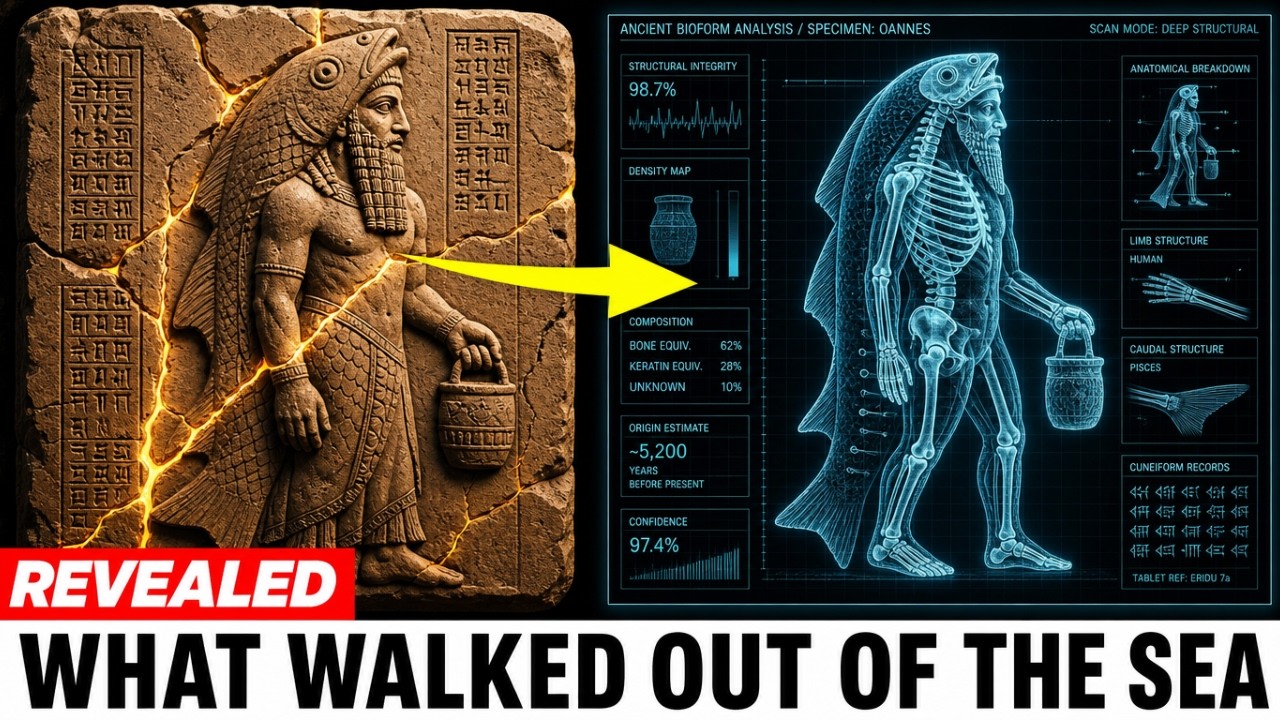
At the absolute center of this baffling tradition stands a figure known as Oannes—or U-Anna in the earliest Sumerian tongues. According to the third-century BCE Babylonian priest Berossus, who translated these ancient records, Oannes was a paradoxical marvel to behold. He possessed the external form of a fish, yet beneath that aquatic facade beat a profoundly human intellect. A secondary human head rested beneath the fish’s head, and human feet extended from its tail, enabling this creature of the deep to walk among men by day and retreat to the waves by night.
What walked out of the sea was not a monster, but the ultimate architect of human intellect. Oannes did not conquer; he educated. In an age when humanity lived like beasts without order or structure, this enigmatic being taught the primitive populace how to read, write, and master mathematics. He demonstrated how to compile laws, construct massive temples, and build cities from the ground up. Through his precise guidance, the wild landscape was transformed into organized fields of agriculture, establishing the very concept of harvest and survival.
Yet, Oannes did not labor alone in this cosmic task of human elevation. The ancient tablets meticulously record a successive lineage of seven semi-divine beings, known collectively as the Apkallu, or the Seven Sages. Sent directly by Enki, the god of wisdom and subterranean waters, each sage arrived with a specific, highly advanced cosmic mandate. Figures like U-Anne-dugga brought comprehensive understanding to the human mind, while others like Enmedugga and Enmegalamma laid down the precise social and spiritual blueprints required to sustain large-scale civilization.
The linguistic weight used by the ancient scribes to describe these beings is intensely deliberate. They were never dismissed as mere myths or simple fairy tales; they were recorded as absolute historical realities, absolute anchors of the pre-flood world. In reliefs unearthed from Nineveh to Nimrud, these Apkallu are carved into stone with fierce, watchful eyes, often depicted with bird-like wings or fish-skin robes. The choice of words in the cuneiform text emphasizes their role as “the guardians of the plans of heaven and earth,” implying they held the keys to a higher, universal intelligence.
This profound golden age of direct instruction came to an abrupt, violent halt with the arrival of the Great Flood. The texts tell us that as the catastrophic waters cleansed the earth, these seven immortal mentors withdrew from the mortal realm, descending permanently back into the Abzu—the primordial cosmic ocean. When the mud dried and humanity emerged to rebuild, the Apkallu were gone. They were replaced by the Ummanu, entirely human scholars who could only try to preserve and pass down the advanced fragments of knowledge left behind by their divine predecessors.
For modern historians and archaeologists, the persistent legacy of the Apkallu remains a deeply provocative riddle. Whether viewed as an elaborate metaphor for the sudden leap of human cognitive evolution or as an ancient memory of an enigmatic, highly advanced maritime culture, the tablets refuse to be ignored. They stand as a haunting reminder from our ancestors that the foundations of everything we call modern society did not evolve in isolation, but were delivered directly from the depths of the sea.