No One Believed These Clayton Moore Stories! Until They Watched This!
For decades, the standard for an unbelievable Hollywood anecdote sat comfortably in the realm of late-night television lore. It was a story so absurd that nobody believed it—until comedian and radio DJ Jay Thomas sat on David Letterman’s couch and bared his soul. The tale, which later became a sacred Christmas tradition on The Late Show, does not just entertain; it captures a vanished era of pure, unadulterated show business. At its beating heart is Clayton Moore, the actor who didn’t just play The Lone Ranger, but chose to live as him.
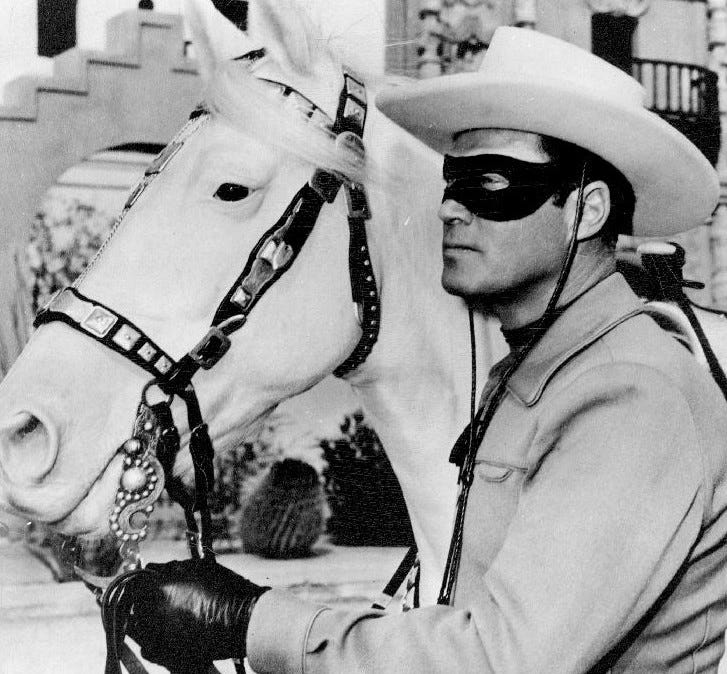
The scene opens in Charlotte, North Carolina, during the cynical, long-haired days of the 1970s. Thomas, then a young, counter-culture disc jockey, found himself hosting a mundane promotional event at a local car dealership. His special guest was none other than Clayton Moore. While modern actors shed their superhero personas the second the director yells cut, Moore operated on a different moral plane. He arrived, stood, and interacted in full, immaculate Western regalia—complete with the trademark mask, the pristine cowboy hat, and the iconic six-shooters. To Moore, the character was a sacred trust, a symbol of American virtue that could never be compromised in public.
The absurdity of reality set in when the promotional event ended and Moore’s scheduled transportation failed to materialize. Stranded and desperate, the legendary hero of the Old West accepted a ride from Thomas and a colleague, two men who epitomized the exact “hippie freak” archetype of the era. The visual imagery alone stretches the limits of imagination: the towering, masked Avenger of Justice squeezed tightly into the passenger seat of a battered, compact Volvo, his knees likely hitting the dashboard, yet maintaining the quiet, stoic dignity of a man riding Silver across the open plains.
What happened next elevated a quirky celebrity encounter into a masterpiece of cosmic justice. While navigating traffic, a middle-aged man driving a luxury Buick backed squarely into the front of Thomas’s compact car, shattering a headlight. Instead of exchanging insurance information, the motorist chose cowardice and sped away. Enraged by the blatant disrespect, Thomas gave chase, eventually cornering the fleeing Buick in a nearby parking lot. It was a tense, modern standoff born of urban frustration, entirely divorced from the romanticized justice of the wild frontier.
When Thomas confronted the driver, the man looked at the two disheveled radio hosts with utter disdain. He flatly denied causing the accident and delivered a taunt dripping with generational arrogance: “Who are they going to believe? Me or two hippie freaks?” It was a calculation based purely on prejudice, a belief that the system would always favor a well-dressed citizen over the counter-culture youth. The driver believed he had won by default, holding all the cards in a society deeply divided by appearance.
Then, the universe corrected itself. The door of the cramped Volvo swung open, and out stepped a figure lifted straight from the silver screen of American childhoods. Clayton Moore, standing tall, imposing, and fully masked under the North Carolina sun, walked toward the confrontation. He did not yell, raise his fists, or draw his pistols. Instead, he looked directly at the stunned, visibly trembling driver. With the flawless, deep baritone delivery that had comforted millions of children across the nation, Moore uttered five immortal words: “I think they’ll believe me, citizen.”
The brilliance of this moment lies entirely in Moore’s phrasing. By addressing the man not as an adversary, but as a “citizen,” Moore instantly recontextualized a petty traffic dispute into a grand act of civic duty. He wasn’t just a passenger in a Volvo; he was the law, the truth, and the unbroken spirit of the American West. It is this unwavering commitment to the bit—or rather, to the code—that transformed a simple late-night talk show segment into an enduring legend, reminding us that sometimes, the heroes we look up to are exactly who we hope they are.