A 4,000-year-old Sumerian stone tablet reveals planets invisible to humans of that time.
For decades, the global scientific community and cultural historians have waged a quiet war against a persistent wave of historical revisionism. At the heart of this modern mythological storm sits a 4,000-year-old Sumerian cylinder seal, officially cataloged as VA 243. For years, pseudoscientific platforms and alternative history enthusiasts have weaponized this artifact, aggressively claiming that the ancient Mesopotamians possessed an impossible cosmic map. This map, they insist, revealed invisible planets long before the invention of the telescope. Yet, a rigorous cross-examination of the archaeological record reveals a starkly different truth, exposing how a singular, flawed interpretation can distort ancient legacy into sensationalist fiction.
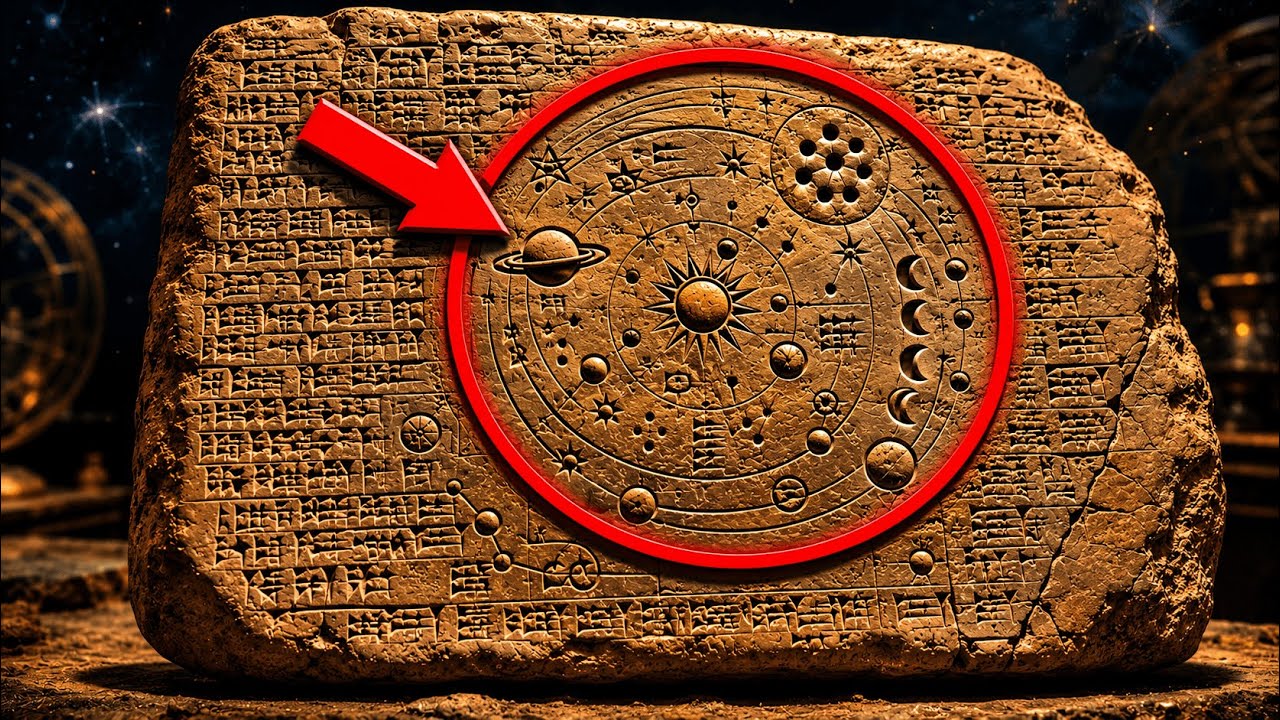
The primary architect of this cosmic fantasy was the late author Zecharia Sitchin, who thrust the artifact into pop-culture infamy with his 1976 book, The 12th Planet. Sitchin claimed that the small, carved stone depicted our Solar System, complete with Uranus, Neptune, and an unmapped rogue planet named Nibiru. To the untrained eye, his assertion felt dangerously compelling, painting the Sumerians not merely as ancient farmers, but as gatekeepers of lost, extraterrestrial knowledge. This narrative spread unchecked through early internet forums, effectively blurring the line between empirical archaeology and imaginative sci-fi. It created a modern myth that continues to mislead millions of readers worldwide.
However, mainstream Assyriologists and planetary scientists have completely dismantled Sitchin’s translation, pointing out critical flaws in his methodology. Dr. Michael S. Heiser, a noted scholar of ancient Semitic languages, led the academic counter-offensive by focusing heavily on the literal text of the seal. When subjected to legitimate linguistic analysis, the cuneiform inscription on VA 243 has absolutely nothing to do with astronomy, celestial mechanics, or outer space. Instead, the text reads as a mundane, highly localized dedication: “Dubsiga, Ili-illat, your servant.” It is a simple message from a citizen to a prominent individual, completely devoid of cosmic secrets.
The visual evidence used to support this extraterrestrial theory crumbles further under strict iconographic scrutiny. The central image on VA 243, long claimed by conspiracy theorists to be our Sun, lacks the essential artistic markers used by Sumerian scribes. In authentic Mesopotamian art, the Sun god Shamash is universally represented by a distinct circle featuring four sharp corners and wavy, alternating celestial rays. The symbol on VA 243 is a standard, multi-pointed star, which ancient artists routinely utilized to signify distant stars or prominent constellations in the night sky. The surrounding dots are not a calculated map of our planetary alignment, but a symbolic, decorative rendering of the broader night sky.
From a purely technological standpoint, attributing such advanced astronomical awareness to the Sumerians defies the physical laws of human optics. The ancient inhabitants of the Tigris and Euphrates valleys were undoubtedly brilliant sky-watchers, meticulously tracking the movements of the cosmos. However, their empirical world was strictly bound by what the human eye could naturally perceive. Their detailed cuneiform tablets confirm they only recognized five planets: Mercury, Venus, Mars, Jupiter, and Saturn. Without complex optical lenses, discovering outer planets like Uranus or Neptune was a physical impossibility, rendering the claim of “invisible planets” scientifically bankrupt.
This ongoing controversy serves as a stark reminder of the ethical dangers of historical sensationalism in the digital age. When writers strip ancient artifacts of their original linguistic and cultural contexts, they actively erase the genuine, hard-earned achievements of early human civilizations. The Sumerians do not need fabricated tales of alien interventions or hidden planetary maps to secure their place in human history. Their true legacy lies in their pioneering mathematics, the invention of writing, and their foundational contributions to agriculture. These real-world triumphs are far more profound than any internet-fabricated conspiracy.
Ultimately, the myth of the 4,000-year-old Sumerian space map belongs firmly in the realm of modern folklore rather than legitimate historical science. By analyzing the physical reality of artifact VA 243, responsible journalism helps restore clarity to a narrative long clouded by profitable sensationalism. True historical exploration requires a deep commitment to verifiable evidence, objective translations, and peer-reviewed analysis. As we look back at the cradle of civilization, we must appreciate the ancient peoples of Mesopotamia for who they truly were: brilliant human innovators navigating a dawn world, entirely under the light of the stars they could see.