Gary Oldman’s Bitter Truth: Why His Failed Marriage to Uma Thurman Still Haunts the Screen Legend
The public knows Gary Oldman as a man of a thousand faces. From the terrifying elegance of Dracula to the stoic grit of Winston Churchill and the chaotic brilliance of Sirius Black, the British actor has spent decades disappearing into complex characters. Yet, behind the chameleon-like artistry lies a personal history marked by turbulent storms. For Oldman, the most challenging role he ever had to play was himself, particularly during a chaotic era that culminated in his short-lived marriage to Hollywood icon Uma Thurman.
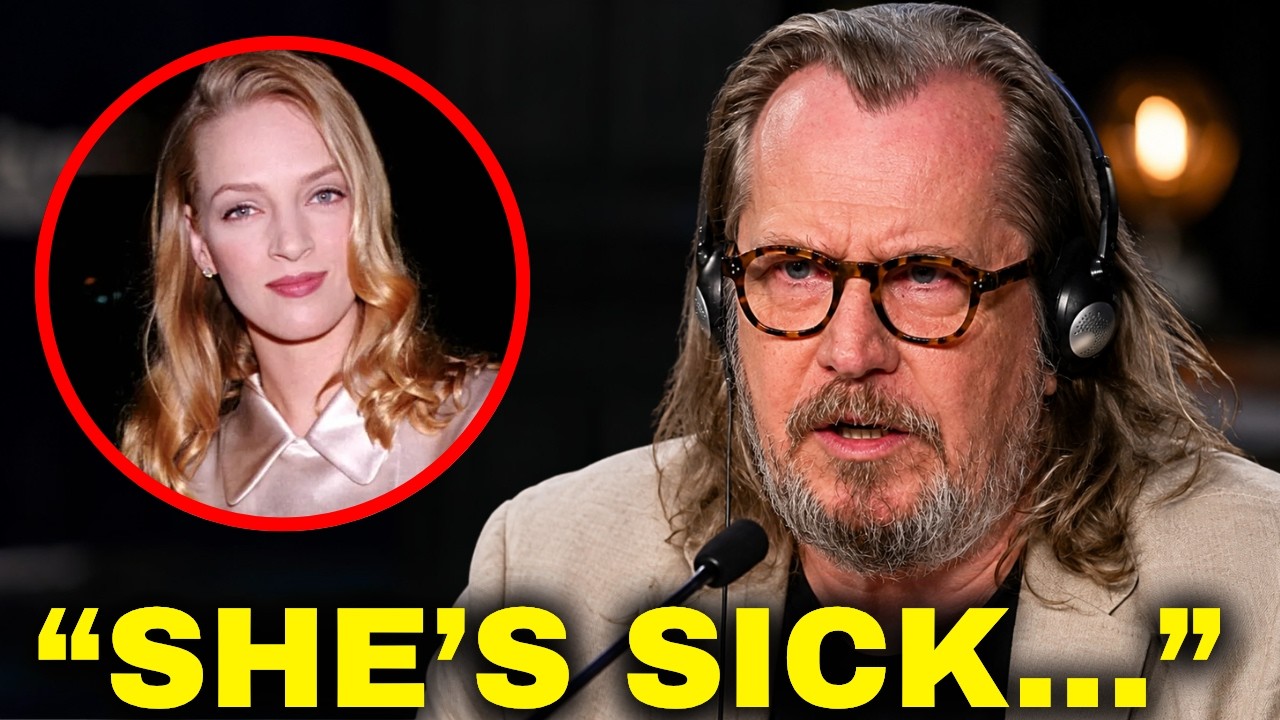
The romance began in 1990 as a whirlwind of intense passion, typical of two fiercely talented individuals operating at the height of cinematic culture. Oldman was the brooding, unpredictable talent from London, while Thurman was the rising, ethereal American star. They captivated the media, yet the relationship burned out almost as quickly as it ignited. Within two short years, the marriage fractured and collapsed, leaving behind a trail of unanswered questions that would linger in Hollywood lore for decades.
At the core of their rapid unraveling was a dangerous cocktail of a significant age gap and Oldman’s severe, ongoing battle with alcoholism. During the early 1990s, Oldman was trapped in a destructive cycle of substance abuse that constantly threatened to derail his life. Thurman, much younger and facing her own rapid rise to stardom, found herself entangled in a chaotic domestic environment that was fundamentally unsustainable, forcing both parties to retreat and separate before the damage became absolute.
Years later, Oldman delivered what sounded like a brutal confession to the press: he admitted that he did not think the marriage ultimately meant very much. To the casual observer, the statement appeared cold, dismissive, and entirely unfeeling toward Thurman. It painted a picture of a man who looked back on a sacred vow with nothing but indifference, sparking fresh rounds of critique regarding his past behavior and emotional maturity.
However, a deeper psychological analysis of Oldman’s life reveals a far more complex reality behind that harsh assessment. The assertion that the marriage lacked meaning was not a slight against Thurman’s character or value. Instead, it was a profound psychological defense mechanism—a conscious effort to shrink a deeply painful, chaotic chapter of his youth that he still felt unable to fully outrun or reconcile with his current self.
Today, Oldman lives a drastically different life, characterized by decades of hard-won sobriety and a quieter, more grounded existence. For a man who has successfully rebuilt his reputation and conquered his personal demons, looking back at the wreckage of the early ’90s brings immense discomfort. Minimizing the historical weight of the marriage serves as an emotional shield, allowing him to distance his sober present from a volatile past.
Ultimately, the story of Gary Oldman and Uma Thurman is not one of callous indifference, but a stark reminder of how addiction distorts love and memory. While the words he chose may sound brutal on the surface, they expose the lasting scars of a legendary actor who can conquer any script, yet still struggles with the heavy, unscripted shadows of his own history.