The Sumerian Tablet That Says Enlil Wanted Humans to Feel Pain — And Describes Why
Deep within the dusty archives of the British Museum lies a collection of clay fragments that completely upends the modern understanding of ancient human suffering. Written in the 18th century BCE, the Atrahasis Epic provides a chilling glimpse into an ancient Mesopotamian world where human agony was not a consequence of sin, but a deliberate bureaucratic solution to a cosmic nuisance. For centuries, humanity has searched for the meaning behind historical disasters, yet this specific cuneiform text reveals an unsettling truth: our oldest ancestors believed their pain was merely a tool to restore quiet to a restless pantheon.
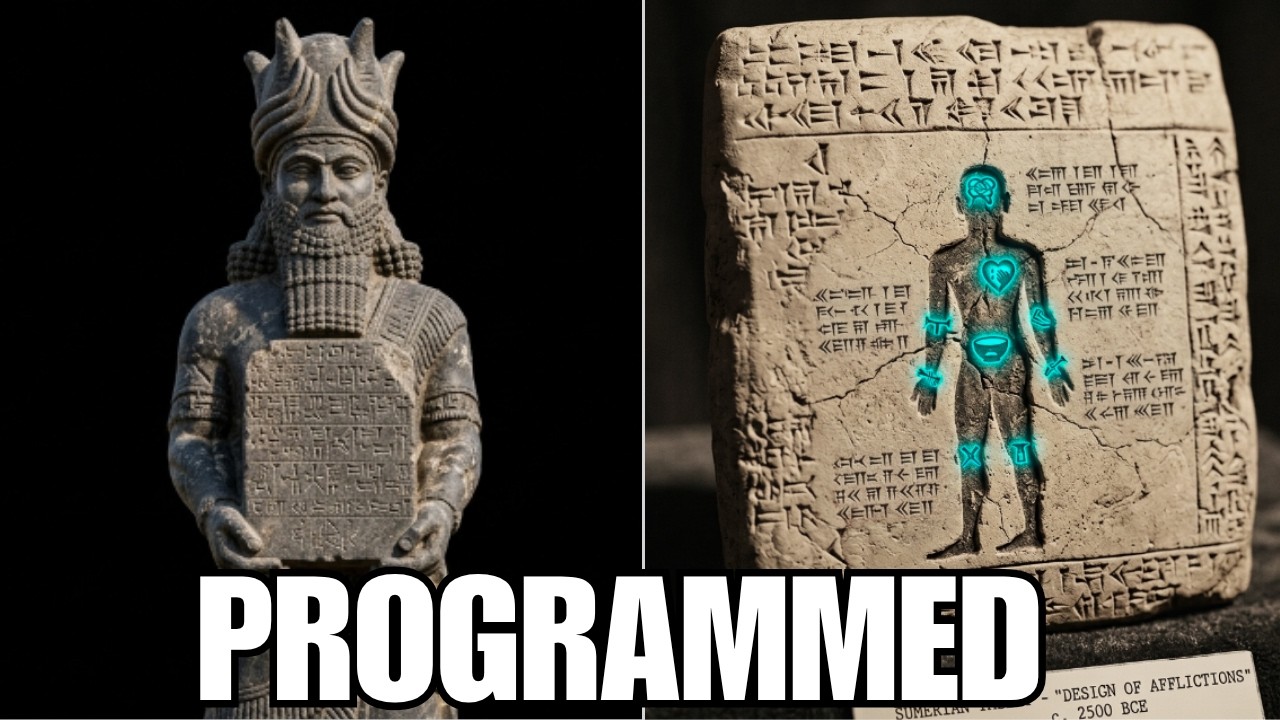
The primary antagonist of this narrative is Enlil, the supreme ruler of the gods and the ultimate enforcer of cosmic order. Far from a benevolent creator, Enlil is depicted as a stern, easily agitated monarch who values absolute quiet above all else. In the earliest days of creation, humans were engineered from clay and divine blood to relieve the lesser gods of their backbreaking labor. However, because these early humans lacked natural mortality, their numbers multiplied exponentially over 1200 years, pushing the planetary limits. Enlil found himself trapped in a sleepless nightmare, unable to rest under the weight of an exploding global population.
The turning point of the epic relies on a powerful linguistic phrase that echoes across millennia: “The country was as noisy as a bellowing bull.” This specific, vivid metaphor highlights the exact nature of Enlil’s rage. The supreme deity was not offended by human wickedness, but physically exhausted by human noise. For a god accustomed to the serene silence of the heavens, the chaotic clamor of everyday life became an unbearable torment. In his desperation to reclaim sleep, Enlil decided that the only way to silence the noise was to systematically reduce the number of people making it.
Driven by this irritation, Enlil orchestrated a series of escalating catastrophes designed to inflict severe pain and suffering upon the human race. He did not act out of sadistic pleasure, but rather used suffering as a pragmatic tool for population control. First, he unleashed a devastating pestilence to sweep through human settlements. When that failed to permanently quiet the world, he ordered a brutal famine and a relentless drought, turning fertile fields into barren wasteland. The text portrays Enlil as a cold calculator, watching human suffering unfold solely to measure whether the global volume was finally dropping.
Yet, humanity was not entirely defenseless, thanks to the clandestine intervention of Enki (Ea), the god of wisdom and human creation. Enki serves as the ultimate moral counterweight to Enlil’s tyranny. Moved by genuine empathy for his creations, Enki constantly worked behind the scenes to undermine Enlil’s cruel decrees. When the plague struck, Enki taught humans how to appease the specific god of pestilence to lift the curse. During the famine, he opened the secret waters of the deep to sustain life. Enki’s actions created a fierce, invisible war of wits between two powerful deities, with human survival hanging delicately in the balance.
The climax of this ancient drama reached its peak when a frustrated Enlil, realizing his minor plagues were continuously thwarted, forced the divine assembly to swear an oath to exterminate humanity once and for all via a Great Flood. It was here that Enki chose a mortal champion named Atrahasis, a man whose name translates to “Exceedingly Wise.” Defying the divine council, Enki whispered the impending doom to a reed wall, knowing Atrahasis would hear. Following Enki’s precise instructions, Atrahasis constructed a massive ark, preserving the seeds of human and animal life through the catastrophic deluge that washed over the earth.
When the waters finally receded, the gods realized that they depended on human sacrifices for sustenance, leading to a permanent compromise. The Atrahasis Epic concludes not with a clean victory, but with the institutionalization of human pain and limitation. To ensure Enlil would never again be kept awake by a “bellowing” world, the gods introduced natural death, infant mortality, and barrenness into the human condition. For modern readers and SEO analysts exploring ancient history, this artifact remains a sobering reminder of how ancient societies explained the permanent existence of suffering—not as a cosmic accident, but as a deliberate compromise to keep the peace.