The Sumerian Tablet That Describes the Ability Enki Gave Certain Humans — That Still Activates
For millennia, the buried secrets of Mesopotamia have fueled intense speculation regarding human origins. Recently, viral internet theories have resurfaced with a compelling claim: a specific Sumerian clay tablet describes a dormant, superhuman ability bestowed by the god Enki that is supposedly “activating” in certain humans today. While these narratives captivate millions online, a responsible look into cuneiform journalism reveals a starkly different, yet infinitely more profound, historical truth.
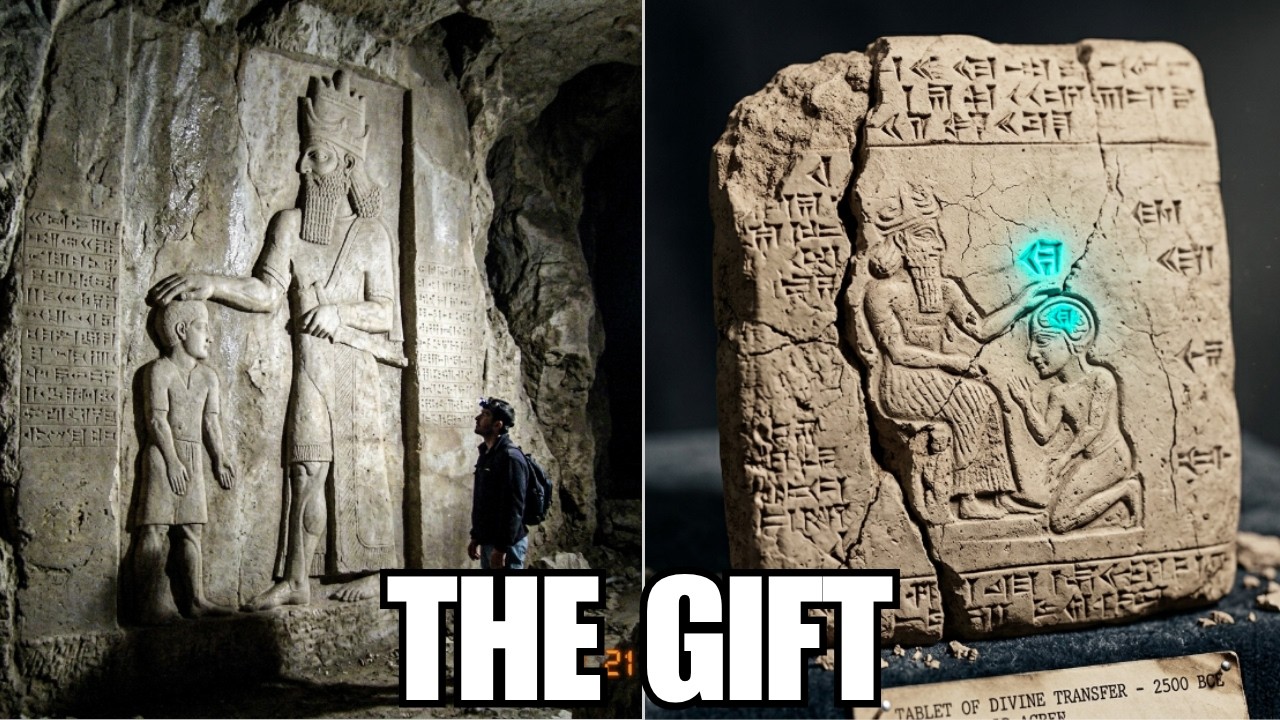
At the heart of this ancient cosmic drama stands Enki, the Sumerian god of wisdom, water, and creation. In authentic cuneiform records such as the Atrahasis Epic and the myth of Enki and Ninmah, Enki is portrayed not as a genetic engineer plotting a futuristic evolution, but as a master craftsman solving a divine crisis. The junior deities, known as the Igigi, had revolted against their grueling labor of digging canals. To restore cosmic order, Enki formulated a groundbreaking solution: shaping humanity from clay and the blood of a slain god.
This act of creation established a unique relationship between humanity and its creator. Enki did not grant humans dormant biological superpowers; instead, he endowed them with wisdom, intellect, and creativity. According to the tablets, humans were designed to inherit the physical burdens of the earth, but they were uniquely equipped with a spark of divine intelligence to help them build tools, cultivate lands, and manage the complex machinery of early civilization.
Central to Enki’s governance was the distribution of the ME—the sacred, immutable decrees that formed the bedrock of Sumerian culture. These ME were not hidden genetic sequences meant to trigger over millennia; they were tangible, institutional concepts covering everything from high priesthood and kingship to metalworking, weaving, and the arts. Enki held these cosmic blueprints at his seat in Eridu, systematically distributing them to elevate humanity from primitive survival to structured, civilized life.
The depth of Enki’s dedication to his creation is best highlighted during humanity’s darkest hour: the Great Flood. When the supreme deity Enlil grew furious at the deafening clamor of a multiplying human population, he decreed their total annihilation. Defying the divine council, Enki acted as humanity’s ultimate protector. He whispered the impending doom through a reed wall to the mortal sage Atrahasis, providing precise instructions to build a massive ark, thereby ensuring the survival of the human seed.
Modern claims regarding “DNA activation” and hidden cosmic timelines do not exist within the thousands of recovered cuneiform fragments. Instead, these interpretations trace back to 20th-century speculative writers who overlaid contemporary science fiction onto ancient mythology. Scholars working with the Electronic Text Corpus of Sumerian Literature at Oxford University consistently confirm that the ancient scribes recorded a history of survival, social duty, and structural intellect rather than biological transformation.
Ultimately, the true legacy preserved in the Sumerian tablets is far more empowering than any viral conspiracy. It is the story of a fragile species that survived catastrophic deluges and cosmic shifts not through magical genetic triggers, but through resilience, intellect, and shared knowledge. For the modern reader, the ancient texts serve as a powerful reminder that our greatest inherited “ability”—the one that continuously activates—is our capacity for wisdom, innovation, and enduring survival.