The Sumerian Tablet That Names Who Brought the Moon Here & What They Left Inside It
In the depths of modern digital folklore, a sensational claim frequently resurfaces to captivate the public imagination: the existence of an ancient Sumerian clay tablet that allegedly names the extraterrestrial architects who towed the Moon into Earth’s orbit, along with a detailed inventory of the bizarre machinery left hidden inside its hollow core. It is a narrative engineered for the viral age, blending the mystique of humanity’s oldest civilization with the thrilling tropes of science fiction. Yet, beneath the glittering veneer of this cosmic conspiracy lies a profound disconnect between historical reality and internet mythology, serving as a cautionary tale of how easily genuine archaeology can be hijacked for clicks.
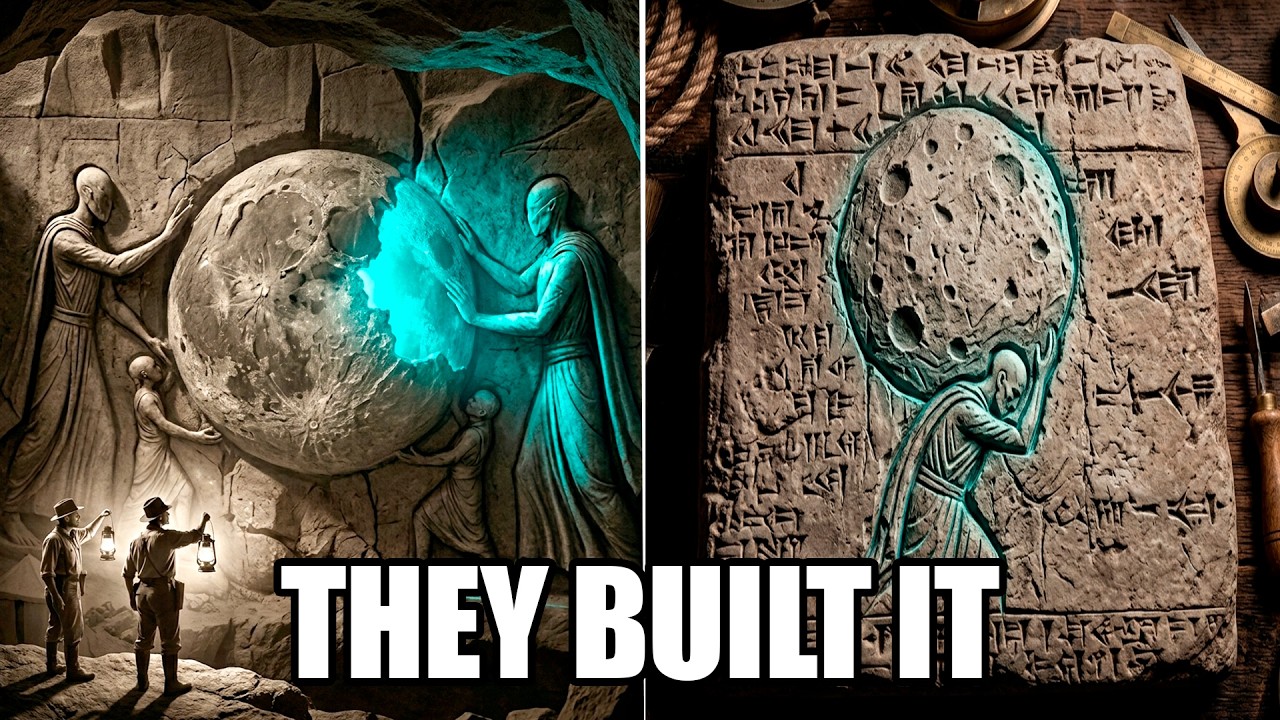
To understand the anatomy of this myth, one must look closely at the “characters” driving the narrative—both ancient and modern. On one hand, we have the ancient Sumerian scribes, meticulous chroniclers of the cosmos who looked up at the night sky over five thousand years ago. On the other hand, we have modern alternative authors, most notably Zecharia Sitchin, whose highly controversial 20th-century books reinterpreted cuneiform texts through a deeply speculative lens. By treating poetic metaphors as literal engineering blueprints, fringe theorists transformed Nanna, the revered Sumerian lunar deity, from a sacred symbol of time and agriculture into a high-tech alien commander piloting a celestial megastructure.
However, when we brush away the dust of internet sensationalism and examine the actual artifacts housed in the world’s leading museums, a completely different picture emerges. Genuine cuneiform tablets reveal that the Sumerians were brilliant, naked-eye astronomers, not science-fiction writers. They carefully tracked the lunar phases to construct a complex agricultural calendar, which was essential for the survival of their civilization. Nowhere in the vast corpus of recovered Mesopotamian literature—from royal inscriptions to religious hymns—is there a single mention of an artificial Moon, a hollow interior, or an alien crew.
The captivating concept of a “Spaceship Moon” or “Hollow Moon” actually has a much more recent, and entirely human, origin story. It was first formally proposed in 1970 not by ancient Mesopotamians, but by two Soviet researchers, Michael Vasin and Alexander Shcherbakov, in an article titled “Is the Moon the Creation of Alien Intelligence?” This Cold War-era hypothesis was a speculative thought experiment, yet over the decades, it morphed, fused with Sitchin’s mistranslations, and was falsely backdated thousands of years to give it an aura of ancient authority. By attributing 20th-century sci-fi ideas to the Sumerians, modern mythmakers created a perfect storm of viral misinformation.
From a scientific standpoint, planetary geology has long since put the “Hollow Moon” fantasy to rest. Decades of data gathered by NASA’s Apollo missions, including seismic experiments that measured how shockwaves travel through the lunar interior, have proven definitively that the Moon is a solid, naturally formed body with a differentiated crust, mantle, and core. It behaves exactly as a natural satellite should, born from a cosmic collision billions of years ago. The idea of a hollow metallic shell filled with alien technology remains firmly in the realm of Hollywood fiction, contradicted by every piece of empirical evidence available to modern science.
As responsible consumers of information in the digital era, the persistence of the Sumerian Moon myth highlights a growing challenge: the erosion of objective truth in favor of sensationalism. When algorithms prioritize engagement over accuracy, fabricated mysteries often overshadow genuine historical achievements. For a true journalist, the duty is clear—to dismantle these lucrative illusions and redirect the public’s wonder toward the real, awe-inspiring triumphs of our ancestors. The Sumerians did not need extraterrestrial visitors to build the foundations of human civilization; their own ingenuity was more than enough.
Ultimately, the true legacy of the Sumerian people requires no exaggeration. By inventing one of the world’s earliest writing systems, pioneering mathematics, and mapping the movements of the stars, they laid the groundwork for the modern world. Demystifying the fake narrative of an alien-made Moon does not diminish the wonder of the ancient past; rather, it restores honor to the actual human beings who stood in the cradles of civilization. Their true story, written in stone and verified by rigorous scholarship, is far more remarkable than any internet hoax.